Dive deep into the spectral pipers, royal betrayals, and the mysterious Stone of Destiny that haunt the historic halls and volcanic foundations of Edinburgh Castle.
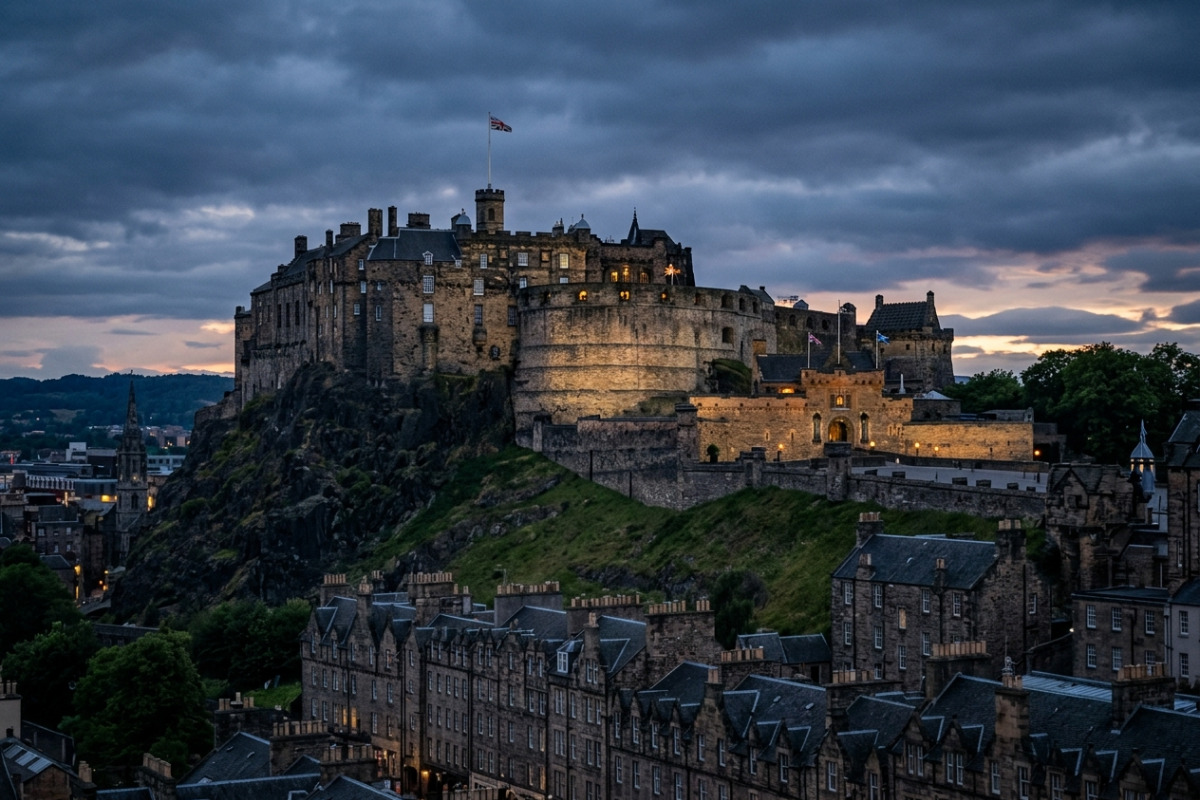
Edinburgh Castle stands as a sentinel over the city, its imposing structure perched atop the rugged basalt of Castle Rock—an extinct volcano that has witnessed over three millennia of human activity. However, beyond the formidable stone walls and the meticulously choreographed royal ceremonies, the castle serves as a treasure trove of myths and legends that continue to enchant and unsettle visitors in equal measure. These stories do more than just enrich the visitor experience; they act as a psychological bridge, connecting us to the visceral fears and grand ambitions of Scotland's ancestors. In this expanded exploration, we will delve into the most fascinating myths associated with Edinburgh Castle, shedding light on the tales that have shaped its legacy, from spectral musicians to the dark inspirations for modern pop culture.
The Lone Piper: A Melody Trapped in Time
No exploration of Edinburgh Castle's legends would be complete without mentioning the tale of the Lone Piper. Centuries ago, a series of secret tunnels was discovered beneath the castle, purportedly stretching from the Royal Palace all the way down the Royal Mile to Holyrood House. To confirm their extent, a young piper was sent into the depths, instructed to play his pipes continuously so that those above could track his progress through the streets.
As the music echoed beneath the cobblestones, the sound suddenly ceased near the Tron Kirk. Despite extensive search parties, the piper was never found. Legend has it that his ghost still wanders these subterranean passages, playing a haunting, muffled melody that can occasionally be heard by those standing quietly in the Royal Mile or the castle’s lower vaults. Unlike many generic ghost stories, this legend was given a scientific lens in 2001 during the Edinburgh International Science Festival, where researchers led by Dr. Richard Wiseman conducted one of the largest paranormal investigations in history. While they didn't find the piper, the high frequency of anomalous reports in the specific areas associated with the legend suggests that the 'Lone Piper' remains one of the castle's most persistent and atmospheric enigmas.
The Headless Drummer and the Omen of War
While many castles claim a resident ghost, few possess a specter as specific in his purpose as the 'Headless Drummer.' First reported in 1650, this spectral figure is believed to appear only when the castle—and by extension, Scotland—is under direct threat. Witnesses describe the sound of a rhythmic, booming drumbeat echoing from the battlements, often accompanied by the sight of a figure wandering the walls, lacking a head.
Historically, the 1650 sighting coincided with the arrival of Oliver Cromwell’s New Model Army. The drummer was seen as a supernatural warning of the impending siege and the subsequent fall of the castle to English forces. Unlike the Piper, who represents a tragic loss, the Headless Drummer is a figure of martial omen. His presence serves as a reminder of the castle's primary function: a fortress that has seen more sieges than almost any other place in Great Britain. To this day, some staff and night watchmen claim to hear the faint, rhythmic 'thump-thump' of a drum on misty nights, a sound that predates the modern One O'Clock Gun by centuries.
The Black Dinner: The Dark Reality Behind the Legend
One of the most chilling legends of Edinburgh Castle is not a ghost story, but a tale of cold-blooded political betrayal known as 'The Black Dinner.' In 1440, the 16-year-old William Douglas, 6th Earl of Douglas, and his younger brother were invited to the castle to dine with the young King James II. The Douglas clan was becoming too powerful, threatening the advisors of the boy-king.
According to legend, at the end of the feast, a black bull's head—a symbol of death—was placed on the table. Despite the young King’s pleas for mercy, the Douglas brothers were dragged out to the castle yard and executed on trumped-up charges of treason. This brutal event became a cornerstone of Scottish folklore and served as the primary inspiration for George R.R. Martin’s 'Red Wedding' in the *Game of Thrones* series. The legend reminds visitors that the castle's beauty often masks a history of ruthless power struggles where the laws of hospitality were bloodily ignored.
The Stone of Destiny: Ancient Magic or Medieval Ruse?
The Crown Jewels of Scotland, or the 'Honours of Scotland,' are housed within the castle, but the most mythologically significant object among them is the Stone of Destiny (the Stone of Scone). Legend says this was the biblical Jacob’s Pillow, brought to Scotland via Ireland and Egypt. It served for centuries as the seat upon which Scottish kings were inaugurated.
A fascinating 'counter-myth' suggests that the stone currently residing in the castle—and used in the coronation of King Charles III—might actually be a 13th-century fake. When King Edward I of England invaded in 1296 to seize the stone, legend has it that the monks at Scone Abbey replaced the real, ornate stone with a piece of common Perthshire sandstone, which Edward then took to Westminster. If true, the real Stone of Destiny remains hidden somewhere in the Scottish Highlands, waiting for a time of great national need to be rediscovered. This layer of mystery adds a unique 'detective' element to any visit to the Crown Room.
The Witches of Castle Hill
The area immediately outside the castle gates, known as the Esplanade, holds a darker legend involving the 'Witches' Well.' During the 16th and 17th centuries, more people were burned at the stake for witchcraft on this spot than anywhere else in Scotland. The most famous 'myth' involves Janet Douglas, Lady Glamis. Accused of witchcraft and plotting against King James V, she was burned alive in front of her young son in 1537.
While historical records confirm her execution, the legend has evolved to portray her as the 'Grey Lady' who haunts the castle. Unlike the malevolent spirits often depicted in horror, the Grey Lady is described as a figure of profound sadness, often seen near the Royal Palace. Her story highlights the intersection of royal paranoia and the tragic superstitions of the era, providing a sobering contrast to the more whimsical elements of Scottish folklore.
The Dungeons and the French Prisoners
Beneath the Great Hall lie the atmospheric vaults that once served as a prisoner-of-war camp during the Napoleonic Wars. While many stories focus on the ghosts of the French prisoners, the true 'legend' lies in the physical evidence they left behind. In 1811, 49 prisoners managed a daring escape by cutting a hole through the castle wall and scaling down the sheer cliffs of Castle Rock. One prisoner unfortunately fell to his death, and his spirit is said to still wander the 'Devil’s Elbow' on the rock face.
The vaults themselves are filled with intricate carvings in the wooden doors and stone walls made by these men. These carvings, featuring ships and symbols of home, have given rise to the myth that the castle 'remembers' its captives. Visitors often report a feeling of being watched in these cold, dark spaces, where the boundary between historical fact and supernatural legend becomes blurred by the sheer weight of past suffering.
Conclusion: A Living Tapestry of Lore
Edinburgh Castle is far more than a collection of historic buildings; it is a living tapestry of myths, legends, and stories that resonate through time. From the tragic notes of the Lone Piper to the dark political theater of the Black Dinner, these tales provide a psychological depth to the physical structure. They remind us that history is not just a series of dates, but a collection of human experiences—hopes, fears, and betrayals—that refuse to be forgotten.
As you explore the castle, from the heights of Mons Meg to the depths of the Crown Room, take a moment to reflect on the tales that have shaped its legacy. Whether you are a skeptic or a believer in the paranormal, the legends of Edinburgh Castle offer a unique lens through which to view the soul of Scotland. For more information on planning your visit and perhaps experiencing these legends for yourself, check out our Visiting Information.
Enjoyed this article?
Share it with friends and fellow castle enthusiasts.